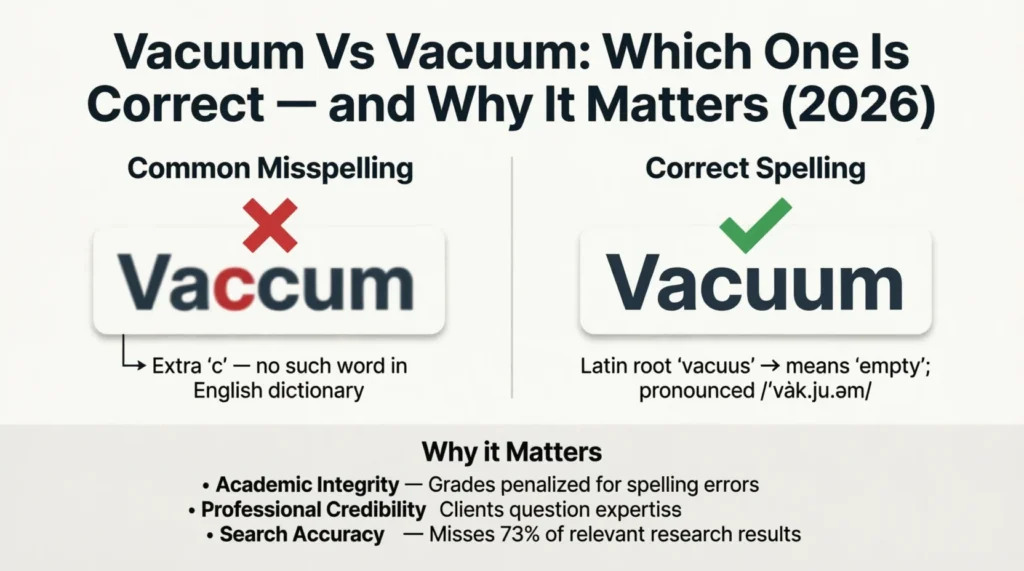
In short, vacuum is the correct spelling used in standard English, while “vaccum” is a common misspelling that appears due to typing habits and pronunciation confusion. If you’ve ever hesitated between vaccum vs vacuum while writing, you’re not alone—and by the end of this guide, you’ll know exactly how to get it right every time.
The Confusion Around vaccum vs vacuum
You’re typing a school essay late at night, and suddenly you pause. Is it vaccum vs vacuum? You stare at the word so long that it stops looking real. A professional writing an email might have the same moment of doubt, quickly backspacing before sending.
This confusion happens more often than you think. Even confident writers second-guess themselves when vaccum vs vacuum appears in their writing. You might feel like it should be simple, but English spelling often has these small traps that catch you off guard.
The tricky part is that your brain already knows the word when you say it aloud. But when you try to write it, your fingers sometimes drop a letter or double one by accident. That’s where the confusion begins.
What Each Word Actually Means
Let’s clear this up in a simple, friendly way so you don’t feel stuck anymore.
The correct word is vacuum. It is a noun (and sometimes a verb). As a noun, it refers to a space with no matter, or more commonly, a machine used for cleaning floors. As a verb, it means to clean something using a vacuum cleaner.
Example sentence: You used the vacuum to clean your room before guests arrived.
Now, “vaccum” is not a real English word. It is simply a spelling mistake. It does not have any official meaning in grammar or dictionaries. When you write vaccum vs vacuum, only one side of that comparison is actually valid.
Example of incorrect usage: You vaccum the carpet every Saturday. (This should be corrected to “vacuum.”)
When you understand this difference, you immediately become more confident in your writing.
vaccum vs vacuum: Side-by-Side Comparison
Here is a quick breakdown to make the vaccum vs vacuum easier to compare at a glance.
Feature
vaccum
vacuum
Meaning
Misspelling of vacuum
Empty space or cleaning device
Part of Speech
Not a standard word
Noun or verb
Formality
Not acceptable
Neutral
Common Context
Typing mistakes
Science, cleaning, technology
Example Sentence
The vaccum is loud.
The vacuum is loud.
Can They Be Swapped?
No
No
Why People Mix Up vaccum vs vacuum
There are a few reasons why vaccum vs vacuum confuses so many people, and linguists often point to predictable patterns in human typing behavior.
First, the double “u” in vacuum feels unusual. In English, double vowels don’t always follow predictable rules, so your brain tries to simplify it. That’s why you might accidentally drop one letter and end up with “vaccum.”
Second, pronunciation doesn’t clearly highlight the spelling. When you say “vacuum” quickly, it can sound like it has fewer syllables than it actually does. Your ear doesn’t strongly warn you that something is missing.
Finally, keyboard typing habits play a role. When you’re typing fast, your fingers often skip or repeat letters. That’s how vaccum vs vacuum becomes one of the most common spelling slip-ups in everyday writing.
The Simple Rule to Remember Which Is Which
Here’s a simple trick that will save you every time you get stuck on vaccum vs vacuum:
A vacuum always needs two “u” letters because it creates an empty “space” in the middle—just like the double letters create space in the word.
Think of it like this: if you remove one “u,” the word collapses just like a vacuum loses its meaning.
Try applying this rule:
You use a vacuum to clean your floor every weekend.
When you forget the second “u,” you are making a spelling mistake.
You should always double-check vacuum before sending your message.
Once you practice this a few times, you’ll stop second-guessing yourself.
Common Mistakes People Make With vaccum vs vacuum
You write “vaccum cleaner is broken” instead of “vacuum cleaner is broken.” The mistake is missing a letter, and the correct version restores the proper spelling.
You type “I need to vaccum the house” instead of “I need to vacuum the house.” The correction is adding the missing “u.”
You assume both spellings are acceptable in informal writing. In reality, only “vacuum” is correct.
You rely on autocorrect too much and never learn the correct spelling yourself. The fix is to consciously practice vacuum until it feels natural.
Each of these mistakes is very common, especially when you are typing quickly or multitasking.
Real Sentence Fix — vaccum vs vacuum
See the Mistake, Fix the Mistake
These are real mistakes people make with vaccum vs vacuum — and the simple fix for each one.
❌ Please order a new vaccum for the office kitchen. ✅ Please order a new vacuum for the office kitchen. 📌 Why:Vacuum is the correct spelling in professional writing.
❌ My vaccum finally stopped working today. ✅ My vacuum finally stopped working today. 📌 Why: The correct word always includes two u letters.
❌ The experiment was performed in a vaccum chamber. ✅ The experiment was performed in a vacuum chamber. 📌 Why: Scientific writing uses the standard spelling vacuum.
❌ The robot vaccum cleaned the whole room. ✅ The robot vacuum cleaned the whole room. 📌 Why: Product names and tech terms use the correct spelling vacuum.
❌ Can you vaccum the living room before dinner? ✅ Can you vacuum the living room before dinner? 📌 Why: When used as a verb, the correct spelling is still vacuum.
❌ We need to empty the vaccum before using it again. ✅ We need to empty the vacuum before using it again. 📌 Why:Vaccum is a common typo, but vacuum is the only correct spelling.
Real-World Examples: vaccum vs vacuum Used Correctly
You might say in casual conversation: “I forgot to use the vacuum before leaving the house.” This is correct because you are referring to a cleaning device in everyday speech.
In a professional email, you could write: “The office vacuum needs maintenance this week.” This is correct and keeps your writing polished.
In academic writing, you might explain: “A vacuum is defined as a space devoid of matter.” This shows correct technical usage.
In creative writing, you could write: “The spaceship drifted through the vacuum of space.” This is correct and adds dramatic effect.
Each example shows how you naturally use vacuum in different situations without confusion once you know the rule.
British English vs. American English — Does It Affect vaccum vs vacuum?
In this case, there is no regional spelling difference affecting vaccum vs vacuum. Both British English and American English use vacuum as the standard spelling.
That means “vaccum” is incorrect in both versions of English, and you should avoid it regardless of where you are writing.
Language researchers often note that some spelling variations exist between regions, but this is not one of them. So whether you are writing in London or New York, the correct choice remains the same.
What Grammar Checkers and Style Guides Say About vaccum vs vacuum
Grammar tools and style guides consistently flag “vaccum” as incorrect and suggest “vacuum” as the correction. This is one of those spelling errors that is almost always caught automatically.
However, relying only on tools is not enough. Sometimes you might be working in environments where autocorrect is off, or you are writing quickly and don’t notice the correction.
Style guides emphasize that understanding the correct spelling yourself is far more reliable than depending on software. Once you internalize vacuum, you won’t need to think twice.
vaccum vs vacuum in Professional and Academic Writing
In professional writing, getting vaccum vs vacuum right matters more than you might think. Small spelling errors can affect how polished your work looks, especially in resumes, emails, or reports.
If you repeatedly write “vaccum,” readers may assume you are careless, even if your ideas are strong. That is why attention to spelling details matters.
In academic writing, precision is even more important. You want your work to reflect clarity and correctness in every detail. Once you understand the correct spelling, you remove one more source of doubt from your writing process.
The good news is that this is an easy fix. Once you learn it, you will almost never confuse it again.
Quick Recap: vaccum vs vacuum at a Glance
“Vacuum” is the only correct spelling
“Vaccum” is always a spelling mistake
The correct word has two “u” letters
Both British and American English use “vacuum”
You can avoid mistakes by remembering the double “u” rule
Frequently Asked Questions About vaccum vs vacuum
Is it vaccum or vacuum in British English?
The correct spelling in British English is “vacuum.” “Vaccum” is incorrect in all regions, so you should avoid it regardless of location.
Why do people spell vacuum as vaccum?
People often misspell vacuum as vaccum because they accidentally drop one of the “u” letters when typing quickly or relying on sound alone.
Is vaccum ever correct in any context?
No, “vaccum” is never correct in standard English. It is always considered a spelling error in both informal and formal writing.
How do you remember the spelling of vacuum?
A simple way is to remember that vacuum has two “u” letters, like two empty spaces inside the word, helping you avoid confusion.
Does autocorrect fix vaccum to vacuum?
Yes, most grammar tools and autocorrect systems will automatically correct vaccum to vacuum, but it’s still important to learn the correct spelling yourself.
Final Thoughts on vaccum vs vacuum
The confusion between vaccum vs vacuum is extremely common, but the solution is simple once you see it clearly. The correct spelling is always “vacuum,” and “vaccum” is just a frequent typing mistake.
Now that you understand the rule, you can write with more confidence in emails, essays, and everyday communication. This small improvement makes your writing cleaner and more professional, and you won’t have to hesitate the next time the word appears.
You’ve now mastered one of those tiny but important details that make your writing stronger every day.
Frequently Asked Questions
What is the correct spelling: vaccum or vacuum?▼
The correct spelling is vacuum, which is used in standard English. Vaccum is a common misspelling that often results from typing habits and pronunciation confusion.
What does the word vacuum mean?▼
Vacuum can be used as both a noun and a verb. As a noun, it refers to a space devoid of matter or a machine used for cleaning floors; as a verb, it means to clean something using a vacuum cleaner.
Why do people confuse vaccum and vacuum?▼
People often confuse vaccum and vacuum due to the unusual double ‘u’ in vacuum, which can lead to typing mistakes. Additionally, the pronunciation of vacuum doesn’t clearly indicate its spelling, and fast typing can cause fingers to skip or repeat letters.
Is vaccum a real word?▼
No, vaccum is not a real English word and has no official meaning in grammar or dictionaries. It is simply a spelling mistake for the word vacuum.
How can I remember the correct spelling of vacuum?▼
A helpful trick is to remember that the word vacuum has two ‘u’ letters because it creates an empty ‘space’ in the middle, just like a vacuum itself. If you remove one ‘u,’ the word loses its meaning, helping you recall the correct spelling.
Can vaccum and vacuum be used interchangeably?▼
No, vaccum and vacuum cannot be used interchangeably. Only vacuum is a valid word, while vaccum is a misspelling and should be corrected to vacuum.
What are some common contexts where the word vacuum is used?▼
Vacuum is commonly used in contexts related to cleaning, such as vacuum cleaners, as well as in scientific discussions about empty spaces or vacuums in physics. Understanding its proper use can enhance clarity in both writing and conversation.
Quick Tip: A Memory Trick for the Spelling
“Vacuum” has two u’s because it comes from the Latin vacuus, meaning empty — think “u-u” as in “you, you, nothing here.” If you keep typing “vaccum,” try spelling it out loud as “vac-u-um” to force the second u into muscle memory. Spell-checkers usually catch this one, but it is worth learning by hand since “vacuum” is one of the few English words with a double u.
Emily Thornton holds a Master’s degree in Linguistics from the University of Chicago and has been passionate about language education for over 15 years. Her interest in language developed at a young age, fueled by a curiosity for how intricacies in language shape communication. Emily has authored several guides on grammar usage and works extensively with ESL learners to improve their fluency and confidence in English. Dedicated to clarity, she writes content that demystifies complex spelling and grammar issues, making her contributions invaluable for professionals looking for authoritative and swift language solutions. Emily continues to explore innovative ways to bridge communication gaps through accurate and effective language use. Her blend of academic rigor and practical insight ensures learners across all levels find her advice beneficial.