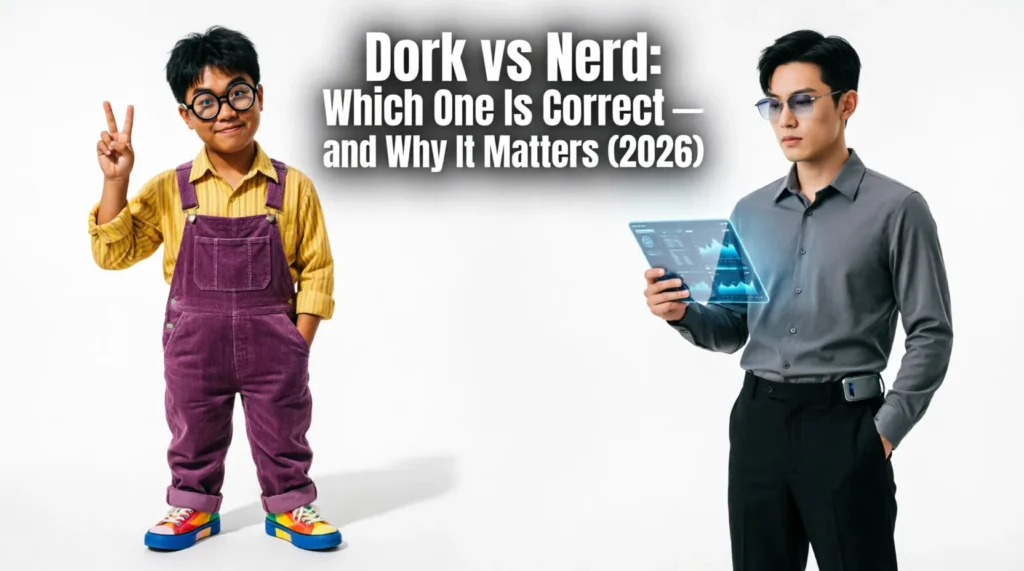
In short, both “dork” and “nerd” are real words, but they describe different kinds of people. A nerd is usually someone deeply interested in intellectual or technical topics, while a dork is often seen as socially awkward or goofy in an endearing way. The difference may seem small, but understanding it can completely change the tone of what you say.
The Confusion Around Dork vs Nerd
You are chatting with friends, writing a social media caption, or describing a classmate in an essay — and suddenly you pause. Should you say someone is a nerd or a dork? Are they basically the same thing, or does one sound harsher than the other?
A lot of people hesitate over dork vs nerd because the words overlap in everyday conversation. Both can describe someone who seems unusual, obsessed with certain interests, or socially awkward. But the emotional tone behind each word is different.
You may even notice people using them interchangeably online, in movies, or at school. That only adds to the confusion. The good news is that once you understand the subtle distinction, choosing the right word becomes much easier.
What Each Word Actually Means
A “nerd” is usually a noun. It describes someone who is highly interested in academic, technical, intellectual, or niche subjects. A nerd might love coding, science fiction, mathematics, gaming strategy, or history.
Example sentence:
“Jamal is a total nerd when it comes to astronomy — he can name every planet’s moons.”
Today, calling someone a nerd is often positive or affectionate. Many people proudly describe themselves that way because it suggests intelligence, passion, and expertise.
A “dork” is also a noun, but it focuses more on awkward behavior, silliness, or lack of social smoothness. A dork may say embarrassing things, laugh too loudly, trip over their own feet, or behave in a goofy way.
Example sentence:
“I felt like such a dork after waving back at someone who wasn’t actually waving at me.”
Unlike “nerd,” the word “dork” is less connected to intelligence or academic interests. It is more about behavior and social presentation.
Sometimes, a person can be both a nerd and a dork. For example, someone might love comic books and also tell painfully awkward jokes at parties.
dork vs nerd: Side-by-Side Comparison
Here is a quick breakdown to make the dork vs nerd easier to compare at a glance.
Feature
Dork
Nerd
Meaning
Socially awkward person
Highly intellectual enthusiast
Part of Speech
Noun
Noun
Formality
Casual
Casual
Common Context
Social behavior discussions
Academic or hobby interests
Example Sentence
He can be a dork sometimes.
She’s a science nerd.
Can They Be Swapped?
Sometimes
Sometimes
Reason
Meanings overlap in some situations.
Meanings overlap in some situations.
Why People Mix Up Dork vs Nerd
The confusion exists because the two words developed similar cultural meanings over time. In movies, television shows, and internet culture, nerdy characters are often portrayed as socially awkward too. That overlap makes people assume the words mean the same thing.
Language researchers also point out that both terms became popular during the late 20th century as labels for people who did not fit traditional social expectations. Because of that shared history, the meanings slowly blended together in casual speech.
Another reason people mix up dork vs nerd is tone. Both words can be playful insults or affectionate descriptions depending on the situation. If you call your best friend a nerd after they explain computer hardware for an hour, it may sound friendly. But calling a stranger a dork could sound rude if the relationship is not close.
Linguists note that context matters more than the dictionary definition here. The speaker’s tone, relationship, and intention all influence how these words are understood.
The Simple Rule to Remember Which Is Which
Here is the easiest way to remember the difference:
A nerd is passionate about knowledge. A dork is awkward in behavior.
That one sentence usually clears up the confusion immediately.
Think about it this way:
If you are talking about intelligence, hobbies, expertise, or obsession with learning, use “nerd.”
If you are talking about clumsy, goofy, embarrassing, or socially awkward behavior, use “dork.”
Examples:
“My brother is a computer nerd who builds gaming PCs for fun.”
“I looked like a dork trying to dance at the wedding.”
“She’s a science nerd but surprisingly confident socially.”
Once you connect nerds with interests and dorks with behavior, the distinction becomes much more natural.
Common Mistakes People Make With Dork vs Nerd
“He’s a dork because he loves physics.” This mixes up intelligence with awkwardness. Correct version: “He’s a nerd because he loves physics.”
“She’s such a nerd for tripping during the presentation.” Tripping is awkward behavior, not intellectual passion. Correct version: “She felt like a dork after tripping during the presentation.”
“All nerds are socially awkward.” This stereotype is outdated and inaccurate. Correct version: “Some nerds are socially awkward, but many are confident and social.”
“Dork means the same thing as geek or nerd.” The words overlap, but they are not identical. Correct version: “Dork, geek, and nerd each carry slightly different meanings.”
Real-World Examples: Dork vs Nerd Used Correctly
Casual conversation: “I’m such a dork — I walked into the wrong classroom today.” Here, “dork” fits because the speaker is describing an embarrassing social mistake.
Professional writing: “The company’s engineering team proudly embraces nerd culture and innovation.” In this case, “nerd” suggests expertise, intelligence, and enthusiasm.
Academic writing: “Researchers have examined how the word ‘nerd’ shifted from insult to identity over recent decades.” This example uses the term analytically and accurately.
Creative writing: “He was a charming dork with untied shoelaces and an awkward smile.” The word creates a vivid image of lovable awkwardness rather than intellectual obsession.
These examples show how context changes which word feels natural.
British English vs. American English — Does It Affect Dork vs Nerd?
Unlike some English word confusions, dork vs nerd is not really about British versus American spelling differences. Both words are widely understood in many English-speaking countries.
However, cultural tone can vary slightly by region. In American English, “nerd” has become much more positive over time, especially in technology and academic culture. Calling someone a nerd can even sound complimentary.
“Dork” still tends to carry a mildly teasing tone almost everywhere. Even so, many people use it affectionately among friends. The confusion exists worldwide because both terms developed through pop culture rather than formal grammar rules.
Real Sentence Fix — dork vs nerd
See the Mistake, Fix the Mistake
These are real mistakes people make with dork vs nerd — and the simple fix for each one.
❌ The new engineer is a dork when it comes to coding and data analysis. ✅ The new engineer is a nerd when it comes to coding and data analysis. 📌 Why: Nerd fits someone known for deep interest or expertise in a subject.
❌ My friend is such a nerd because he tripped over his own shoes. ✅ My friend is such a dork because he tripped over his own shoes. 📌 Why: Dork is often used for awkward behavior rather than expertise.
❌ The professor described Einstein as a dork of physics. ✅ The professor described Einstein as a nerd of physics. 📌 Why: The sentence focuses on strong academic interest and knowledge.
❌ This gaming forum is full of dorks who love discussing hardware specs. ✅ This gaming forum is full of nerds who love discussing hardware specs. 📌 Why: Nerd is the better choice for people deeply interested in technical topics.
❌ I felt like a nerd after waving back at someone who wasn’t waving at me. ✅ I felt like a dork after waving back at someone who wasn’t waving at me. 📌 Why: The situation is socially awkward, which matches dork better.
❌ Everyone calls my sister a dork because she reads astronomy books for fun. ✅ Everyone calls my sister a nerd because she reads astronomy books for fun. 📌 Why: Reading specialized subjects for enjoyment is commonly linked with nerd.
What Grammar Checkers and Style Guides Say About Dork vs Nerd
Most grammar tools will not flag either word because both are correct English nouns. Spellcheck alone cannot tell whether you meant “dork” or “nerd,” since the issue is about meaning and context rather than spelling accuracy.
Style guides and language experts generally recommend choosing the word based on tone. If you want to highlight intelligence or deep interest, “nerd” is the clearer choice. If you want to describe awkward or goofy behavior, “dork” works better.
This is why relying only on autocorrect is not enough. You still need to understand the distinction yourself if you want your writing to sound precise and natural.
Dork vs Nerd in Professional and Academic Writing
In professional settings, word choice affects how people perceive your tone. Calling someone a nerd in a lighthearted workplace conversation may sound playful or even admiring. Calling them a dork, however, could sound less respectful depending on the context.
In academic writing, precision matters even more. If you are analyzing media, culture, or language, using the wrong term can weaken your point. Language researchers often separate “nerd” identity from general social awkwardness for exactly this reason.
You should also remember that both words began as insults historically. Today, many people reclaim “nerd” proudly, especially in technology, gaming, and science communities. “Dork” is still more teasing, so it usually requires careful tone awareness.
Once you understand the difference, though, you will stop second-guessing yourself. The choice becomes surprisingly straightforward.
Quick Recap: Dork vs Nerd at a Glance
A nerd is associated with intelligence, expertise, or intense interests.
A dork is associated with awkward, goofy, or embarrassing behavior.
Someone can be both a nerd and a dork at the same time.
“Nerd” is often positive today, especially in tech and academic culture.
Context and tone matter more than spelling or grammar tools.
Frequently Asked Questions About Dork vs Nerd
Is nerd an insult or a compliment?
It depends on context and tone. Historically, “nerd” was mostly an insult, but today many people use it proudly. In modern culture, it often suggests intelligence, passion, or expertise rather than social failure.
What is the difference between a geek and a nerd?
A geek is usually someone deeply enthusiastic about a hobby, fandom, or interest, especially pop culture or technology. A nerd is more strongly connected to academics, intellectual pursuits, or technical expertise. The meanings overlap, but they are not identical.
Can someone be both a dork and a nerd?
Yes, absolutely. A person might be highly knowledgeable about science or gaming while also acting socially awkward or goofy. The two words describe different traits, so they can apply to the same person.
Why do people confuse dork and nerd?
People confuse them because movies, television, and internet culture often combine intellectual interests with awkward behavior in the same characters. Over time, the meanings started blending together in casual conversation.
Is it rude to call someone a dork?
It can be, depending on your relationship and tone. Among close friends, “dork” is often playful and affectionate. But in formal or unfamiliar situations, it may come across as insulting or dismissive.
Final Thoughts on Dork vs Nerd
The key difference in dork vs nerd is simple: a nerd is defined more by interests and intelligence, while a dork is defined more by awkward behavior. That small distinction changes the meaning quite a bit.
If you have ever mixed them up, you are definitely not alone. This confusion is incredibly common because the words overlap in movies, online culture, and everyday speech.
Now that you understand the difference, you can choose the right word with confidence. Your writing will sound clearer, more natural, and more precise every time you use either term.
Frequently Asked Questions
What is the main difference between a dork and a nerd?▼
A nerd is typically someone who is highly interested in intellectual or technical subjects, while a dork is often characterized by socially awkward or goofy behavior. Understanding this distinction can help clarify the tone of your conversations.
Can the terms dork and nerd be used interchangeably?▼
While both terms can describe someone who is unusual or obsessed with certain interests, their meanings do not fully overlap. Depending on the context, using one term over the other can convey different emotional tones.
How has popular culture influenced the meanings of dork and nerd?▼
In movies and television, nerdy characters are often portrayed as socially awkward, which has led to a blending of the meanings of dork and nerd over time. This shared cultural history contributes to the confusion surrounding the two terms.
Is it acceptable to call someone a dork or a nerd?▼
Yes, but context is crucial. Calling a close friend a nerd in a playful manner can be affectionate, while using the term dork towards a stranger might come off as rude.
Can someone be both a dork and a nerd?▼
Absolutely! A person can enjoy academic pursuits like comic books while also displaying socially awkward behavior, making them both a nerd and a dork. This duality highlights the nuanced nature of these labels.
What role does tone play in the use of dork and nerd?▼
Tone significantly affects how these words are interpreted. The same term can be seen as a playful jab among friends or an insult to an acquaintance, depending on the speaker’s intention and relationship with the person being described.
What common contexts do people use dork and nerd in?▼
Dork is often used in discussions about social behavior, while nerd is more commonly associated with academic or hobby interests. Recognizing these contexts can help you choose the right term for your conversations.
Rebecca Nguyen brings a diverse background in journalism and education to her role at WordlyRight. A graduate of the University of Toronto with a focus in English and Linguistics, she has spent over 12 years honing her skills as a writer and educator. Rebecca’s expertise lies in her ability to simplify daunting grammar rules and rectify frequent spelling mistakes in a way that resonates with students and professionals alike. Her articles on WordlyRight zero in on the most common word confusions encountered by writers, turning complex concepts into clear, actionable insights. With a passion for lifelong learning, Rebecca continually seeks to refine her understanding of language to better serve her audience.