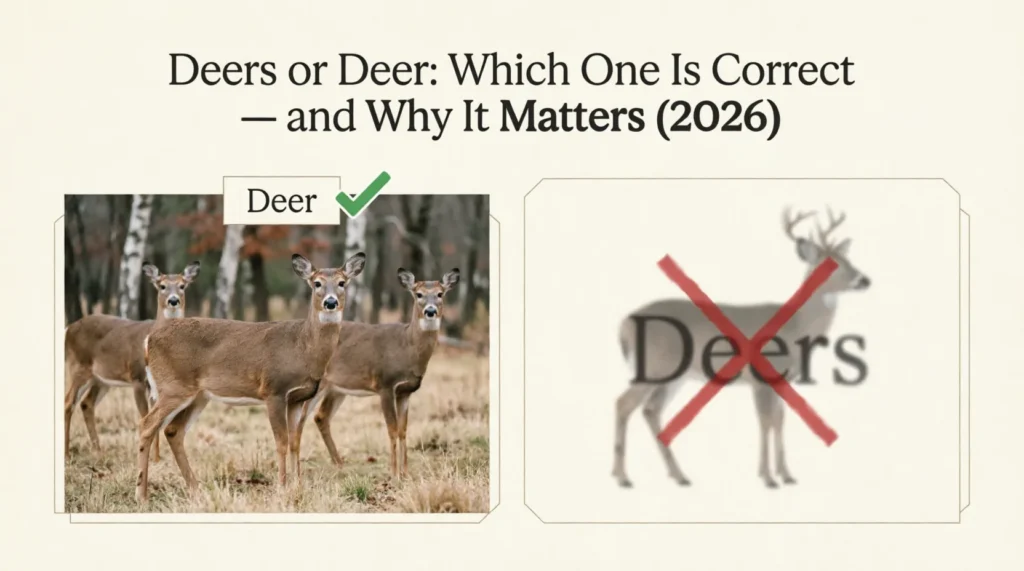
In short, the correct plural form is usually “deer,” not “deers.” You can say “one deer” or “many deer,” because the word keeps the same form in both singular and plural. Still, there are a few rare situations where “deers” appears, and understanding those cases can help you write with much more confidence.
The Confusion Around Deers or Deer
You are halfway through an essay or typing a social media caption when suddenly you pause: is it “deers” or “deer”? It feels like “deers” should be correct because most English nouns add an “s” in the plural form.
That hesitation is incredibly common. English is full of words that follow one pattern until they suddenly do not, and “deer” is one of those words that trips people up all the time.
You might even see both forms online, which makes the confusion worse. When you search for deers or deer, you are really trying to answer a deeper question: when does English follow the rules, and when does it quietly ignore them?
What Each Word Actually Means
“Deer” is the standard singular and plural form of the animal name. It is a noun. You use it whether you are talking about one animal or many.
Example: I saw three deer near the forest this morning.
You would also say: A deer crossed the road last night.
This type of noun is called an “irregular plural.” Instead of adding “-s” or “-es,” the word stays the same. Other examples include “sheep” and “fish” in many contexts.
“Deers,” on the other hand, is usually considered incorrect in everyday English. Most grammar experts and style guides recommend avoiding it in normal writing and speech.
However, there is one important exception. In scientific or biological contexts, researchers sometimes use “deers” when talking about different species of deer rather than multiple animals generally.
Example: The park contains several deers native to different regions.
Even there, many writers still prefer “deer.” So if you are unsure, “deer” is the safer and more widely accepted choice almost every time.
deers or deer: Side-by-Side Comparison
Here is a quick breakdown to make the deers or deer easier to compare at a glance.
Feature
deers
deer
Meaning
Incorrect plural form of deer
One or many deer
Part of Speech
Noun (nonstandard)
Noun
Formality
Incorrect in standard English
Neutral
Common Context
Rare learner mistake
Wildlife, hunting, nature
Example Sentence
We saw deers today.
We saw deer today.
Can They Be Swapped?
No
No — deer is singular and plural
Why People Mix Up Deers or Deer
The confusion exists because English trains you to expect regular plural forms. Most nouns become plural by adding “s” or “es,” so your brain naturally wants to turn “deer” into “deers.”
Language researchers often point out that people learn patterns before exceptions. Once you know that “cats,” “cars,” and “teachers” all add an “s,” it feels logical to assume “deer” should work the same way.
Another reason is that “deer” sounds incomplete to some people when used as a plural. If you say, “I saw five deer,” your ear may expect another ending because English speakers are so used to hearing plural markers.
The internet also contributes to the confusion. You may see “deers” in informal posts, online comments, or translated writing. That repeated exposure can make the incorrect version seem normal, even though major style guides still prefer “deer.”
The Simple Rule to Remember Which Is Which
Here is the easiest rule:
If you are talking about the animal, use “deer” for both one and many.
Think of it this way: deer behave like sheep. You would not normally say “sheeps,” and you usually should not say “deers” either.
Examples:
One deer was standing near the lake.
Six deer were eating in the field.
We photographed several deer during our camping trip.
The word never changes in ordinary use, no matter how many animals you are talking about. Once you remember that pattern, the deers or deer question becomes much easier.
Common Mistakes People Make With Deers or Deer
“We saw many deers in the national park.” The mistake comes from adding a regular plural ending to an irregular noun. Correct version: “We saw many deer in the national park.”
“There was deers near the road.” This mixes a plural noun with singular grammar structure. Correct version: “There were deer near the road.”
“Two deer was running across the field.” The noun is correct, but the verb should match the plural meaning. Correct version: “Two deer were running across the field.”
“Hunters tracked five deers through the forest.” This is a very common writing mistake because “five” sounds like it should require an “s.” Correct version: “Hunters tracked five deer through the forest.”
Real Sentence Fix — deers or deer
See the Mistake, Fix the Mistake
These are real mistakes people make with deers or deer — and the simple fix for each one.
❌ The park ranger counted twelve deers near the river this morning. ✅ The park ranger counted twelve deer near the river this morning. 📌 Why: Deer stays the same whether there is one or many.
❌ We saw three deers while hiking last weekend. ✅ We saw three deer while hiking last weekend. 📌 Why: The plural form is deer, not deers.
❌ My science report explains how deers survive during winter. ✅ My science report explains how deer survive during winter. 📌 Why: Deer is used for groups of the animal too.
❌ The wildlife tracking app recorded five deers in the area. ✅ The wildlife tracking app recorded five deer in the area. 📌 Why: Numbers do not change the plural form of deer.
❌ There are a lot of deers behind our house at night. ✅ There are a lot of deer behind our house at night. 📌 Why: Deer is already the correct plural word.
❌ Our team spotted several deers during the field survey. ✅ Our team spotted several deer during the field survey. 📌 Why: Standard English uses deer for both singular and plural.
Real-World Examples: Deers or Deer Used Correctly
Casual conversation: “We saw deer while driving through the countryside.” Here, “deer” correctly works as the plural form in everyday speech.
Professional writing: “The wildlife reserve protects hundreds of deer each year.” This sentence uses the accepted plural form expected in formal communication.
Academic writing: “Researchers observed deer migration patterns during winter.” Academic English also generally keeps “deer” unchanged in the plural.
Creative writing: “The deer moved silently beneath the moonlit trees.” Even in descriptive or literary writing, the plural remains “deer.”
These examples show that once you learn the pattern, you can use it naturally in almost any situation.
British English vs. American English — Does It Affect Deers or Deer?
Unlike some English word confusions, deers or deer is not mainly a British-versus-American issue. Both British English and American English overwhelmingly prefer “deer” as both the singular and plural form.
That means you do not need to memorize different regional spellings or grammar rules here. Whether you are writing for readers in the United States, the United Kingdom, Pakistan, Canada, or Australia, “deer” is still the standard choice.
Linguists note that this consistency comes from the word’s long history in English. Some older animal names kept their original plural forms instead of adopting the newer “-s” pattern that became common later.
What Grammar Checkers and Style Guides Say About Deers or Deer
Most grammar checkers flag “deers” as incorrect in standard writing. If you type it into a document, there is a good chance autocorrect or spellcheck will suggest changing it to “deer.”
Still, automated tools are not perfect. Some programs may miss the issue if the sentence structure technically allows “deers,” especially in scientific contexts. That is why grammar experts encourage you to understand the rule yourself instead of depending entirely on software.
Major style traditions in English consistently recommend “deer” for normal plural use. Knowing that gives you a reliable answer whenever you face the deers or deer question again.
Deers or Deer in Professional and Academic Writing
In professional and academic writing, small grammar details can shape how readers see your work. Using “deers” in a standard report, article, or application may distract readers because it looks unfamiliar or incorrect.
That does not mean people will think poorly of you. English has many irregular nouns, and even strong writers occasionally second-guess them. But choosing the correct form helps your writing feel polished and trustworthy.
Precision matters in scholarly, legal, and translated writing as well, especially when documents move across languages and traditions. Once you know that “deer” works for both singular and plural, you can write without hesitation.
The good news is that this is one of the easier English irregulars to remember after you see the pattern a few times. From now on, you will probably notice correct usage everywhere.
Quick Recap: Deers or Deer at a Glance
“Deer” is the correct singular form.
“Deer” is also the standard plural form.
“Deers” is usually incorrect in everyday English.
Rare scientific contexts may use “deers” for multiple species.
When in doubt, always choose “deer.”
Frequently Asked Questions About Deers or Deer
Is it correct to say “deers”?
Usually, no. In standard English, the plural of “deer” is still “deer.” Most teachers, editors, and style guides consider “deers” incorrect except in rare scientific discussions about species.
Why is the plural of deer not deers?
English has a group of irregular nouns that do not change in the plural form. “Deer” belongs to that group, along with words like “sheep.” Linguists explain that these forms come from older stages of the English language.
Can you ever use the word “deers”?
Yes, but it is uncommon. Some biological or zoological writing uses “deers” when discussing different species collectively. In normal conversation and writing, though, “deer” is still the preferred form.
Is it one deer or one deers?
The correct singular form is “one deer.” You would never normally say “one deers.”
What is the plural form of deer?
The standard plural form is “deer.” For example: “We saw five deer near the river.”
Final Thoughts on Deers or Deer
The answer to deers or deer is simpler than it first appears: in almost every situation, “deer” is correct for both singular and plural use. That single rule will carry you through everyday conversation, academic writing, and professional communication.
If you have ever paused over this word, you are far from alone. English contains many irregular patterns, and this is one of the most common ones people question.
Now that you understand the logic behind it, you can write with much more confidence. The next time you see a group of deer, you will know exactly what to call them without second-guessing yourself.
Frequently Asked Questions
What is the correct plural form of 'deer'?▼
The correct plural form is ‘deer.’ Unlike most English nouns that add an ‘s’ or ‘es,’ ‘deer’ remains unchanged in both singular and plural forms.
In what context might 'deers' be used correctly?▼
The term ‘deers’ can be used in scientific or biological contexts when referring to different species of deer. However, this usage is rare, and most experts recommend using ‘deer’ for both singular and plural.
Why do many people mistakenly say 'deers'?▼
Many people confuse ‘deer’ with regular nouns that form plurals by adding ‘s.’ This expectation leads to the incorrect assumption that ‘deers’ is a valid plural form.
Can 'deer' and 'deers' be used interchangeably in writing?▼
No, ‘deer’ should be used for both singular and plural references, while ‘deers’ is generally considered incorrect in standard English. Using ‘deer’ is the safer and more accepted choice in writing.
What are some examples of other irregular plural nouns like 'deer'?▼
Other examples of irregular plural nouns include ‘sheep’ and ‘fish,’ which also do not follow the typical pattern of adding ‘s’ or ‘es’ for pluralization. These nouns can often cause similar confusion among English learners.
How can I remember to use 'deer' instead of 'deers'?▼
A simple rule to remember is to think of ‘deer’ as behaving like ‘sheep,’ which also does not change in the plural form. If you are talking about the animal, always use ‘deer’ for both one and many.
Where might I commonly see 'deers' used incorrectly?▼
You might encounter ‘deers’ in informal posts, online comments, or translated writing, where the incorrect form can seem more normalized. This frequent exposure can make it easy to mistakenly adopt the incorrect version.
Maria Ramirez is an experienced editor and language consultant with over 10 years in the publishing world. She holds a Bachelor’s degree in Journalism and deeply appreciates the power of the written word. Her expertise lies in dissecting the complexities of English grammar and providing straightforward guidance for contemporary writers. Maria’s work focuses on simplifying spelling and usage rules, assisting both seasoned writers and budding authors in presenting their ideas with precision. Her involvement with WordlyRight stems from a commitment to nurture a global audience’s command over English, ensuring learners and professionals don’t just understand language nuances but use them effectively in varied contexts. As someone who passionately believes in lifelong learning, Maria continuously seeks to inspire this ethos in her readers.