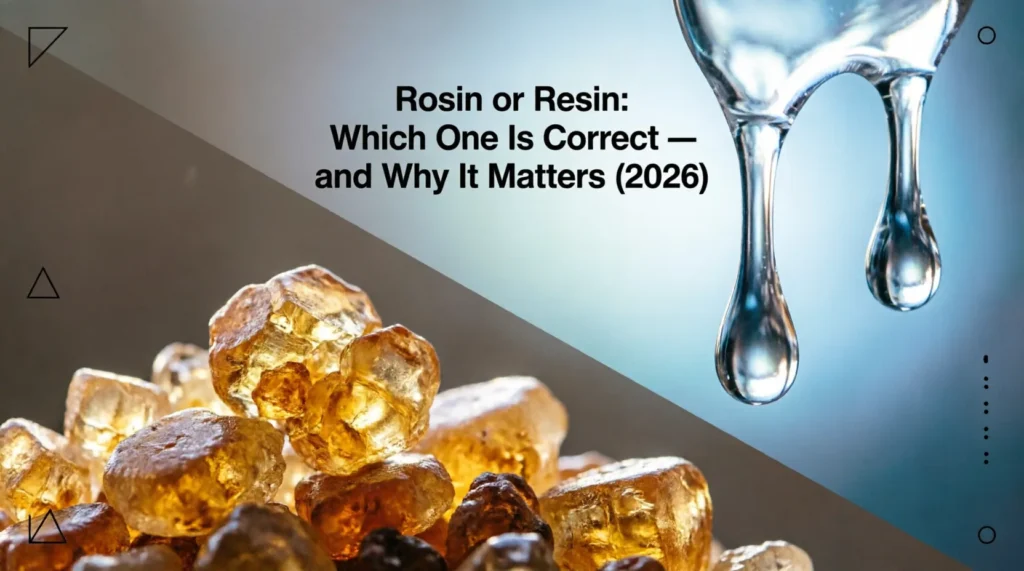
In short, “rosin” and “resin” are both correct words, but they mean completely different things, and mixing them up can change the meaning of your writing. Rosin refers to a solid form of resin used in things like violin bows and sports grips, while resin is a broader sticky substance found in plants or used in plastics and crafts. Understanding the difference helps you avoid one of the most common word confusions in English.
If you’ve ever paused mid-sentence wondering whether you should write rosin or resin, you’re in the right place — the distinction is simpler than it looks once it clicks.
The Confusion Around Rosin or Resin
You might be typing an email, writing a blog post, or even working on a school assignment when suddenly you stop. Is it rosin or resin?
It feels like both words are right. They sound similar when spoken, and they often appear in similar contexts involving materials, music, or chemistry. That overlap is exactly what trips people up.
You’re not alone in this confusion. Many writers second-guess themselves when they see rosin or resin used in different places. The uncertainty usually comes from hearing the words before truly understanding them in writing.
Once you clearly separate their meanings, your confidence in using them grows immediately.
What Each Word Actually Means
Let’s break down rosin or resin in the simplest way possible so you can stop guessing.
Resin is a sticky, natural substance produced by plants, especially trees. It is also used in synthetic materials like plastics, varnishes, and epoxy. In grammar terms, resin is a noun.
Example: The tree oozed resin after being cut, sealing the wound naturally.
Rosin, on the other hand, is a solid form of resin that has been processed by heating. It is often used to add grip or friction, especially for violin bows, ballet shoes, and sports like baseball or gymnastics. Rosin is also a noun.
Example: The violinist applied rosin to the bow to improve sound quality.
So when you compare rosin or resin, remember this: resin is the raw, natural or synthetic material, while rosin is a refined, solid version used for grip and friction.
rosin or resin: Side-by-Side Comparison
Here is a quick breakdown to make rosin or resin easier to compare at a glance.
Feature
rosin
resin
Meaning
Solid tree sap derivative
Sticky plant or synthetic substance
Part of Speech
Noun
Noun
Formality
Neutral
Neutral
Common Context
Music, sports grip use
Crafts, manufacturing, biology
Example Sentence
Violinist applied rosin
Tree produces resin naturally
Can They Be Swapped?
No — different materials
No — different materials
Why People Mix Up Rosin or Resin
The confusion between rosin or resin comes from how closely the words sound. Linguists often point out that English contains many near-identical word pairs where a single vowel change completely alters meaning.
Both words also appear in technical or specialized contexts, which makes them harder to distinguish for everyday writers. You might hear resin in science class and rosin in music or sports, but rarely both side by side.
Another reason is spelling intuition. When you hear the word aloud, your brain naturally fills in what looks “right,” and many people assume rosin is just a variant spelling of resin — which it is not.
The Simple Rule to Remember Which Is Which
Here’s a quick trick that makes rosin or resin easy to remember:
Resin = Raw and sticky (think trees and plastic)
Rosin = Rubbed and refined (think violin bows and grip)
If it’s natural or chemical in origin, you’re dealing with resin. If it’s processed and used to create friction or grip, it’s rosin.
Examples:
The tree releases resin when damaged, which protects it from infection. The baseball player uses rosin to keep a firm grip on the ball. You can think of resin as the “original substance,” while rosin is what you get after refinement.
Common Mistakes People Make With Rosin or Resin
Using “rosin” when talking about tree sap Incorrect: The pine tree produced rosin after being cut. Correct: The pine tree produced resin after being cut.
Using “resin” in music contexts Incorrect: She applied resin to her violin bow. Correct: She applied rosin to her violin bow.
Assuming they are interchangeable Incorrect: The artist used rosin for making jewelry molds. Correct: The artist used resin for making jewelry molds.
Misspelling based on pronunciation Incorrect: The gym floor was coated with resin powder. (when referring to grip powder) Correct: The gym floor was coated with rosin powder.
See the Mistake, Fix the Mistake
These are real mistakes people make with rosin or resin — and the simple fix for each one.
❌ The violin needs resin before the concert. ✅ The violin needs rosin before the concert. 📌 Why: Rosin is used on bows to create grip on strings.
❌ She used rosin to make a clear phone case. ✅ She used resin to make a clear phone case. 📌 Why: Resin is the liquid material used for casting and molds.
❌ The chemistry teacher explained how rosin forms in trees. ✅ The chemistry teacher explained how resin forms in trees. 📌 Why: Resin is the natural substance produced by trees.
❌ I downloaded a resin tool for better guitar sound. ✅ I downloaded a rosin tool for better guitar sound. 📌 Why: Rosin is used with instruments, not software or tools.
❌ He cleaned the skateboard grip with resin. ✅ He cleaned the skateboard grip with rosin. 📌 Why: Rosin is used to improve grip on surfaces like skateboards.
❌ The carpenter added rosin to make the table coating glossy. ✅ The carpenter added resin to make the table coating glossy. 📌 Why: Resin is used in finishes and coatings for wood projects.
Real-World Examples: Rosin or Resin Used Correctly
In science writing: The chemical structure of resin allows it to harden into durable plastics. This shows resin in a materials science context.
In music practice: The violinist carefully applied rosin before the performance. This shows rosin improving friction for sound production.
In casual conversation: I got sap-like resin on my hands while hiking through the forest. This reflects a natural encounter with plant resin.
In crafting: The artist poured epoxy resin into a mold to create a glossy finish. This highlights resin’s use in creative projects.
Each example makes your understanding of rosin or resin more practical and grounded in real usage.
British English vs. American English — Does It Affect Rosin or Resin?
When it comes to rosin or resin, there is no meaningful difference between British and American English spelling. Both terms are spelled the same in all major English varieties.
However, usage frequency can differ slightly. Resin is more commonly used in scientific, industrial, and academic contexts globally, while rosin appears more often in music, sports, and specialized activities.
So no matter where you are writing from, the confusion is universal — not regional. The distinction depends on meaning, not geography.
What Grammar Checkers and Style Guides Say About Rosin or Resin
Grammar tools usually do not flag resin or rosin as errors because both are valid English words. The real issue is context, not spelling.
Style guides emphasize meaning accuracy over spellcheck correction. That means you need to understand which word fits your sentence rather than relying on software suggestions.
Language researchers often highlight this type of confusion as a “false homophone pair,” where similar pronunciation leads to frequent misuse even among experienced writers.
Rosin or Resin in Professional and Academic Writing
Getting rosin or resin right matters more than you might think, especially in professional writing.
If you’re writing a job application, scientific paper, or technical document, using the wrong word can make your work look careless. Even if your overall idea is strong, a single incorrect term can weaken clarity.
In academic writing, precision is everything. Using resin when you mean rosin (or the other way around) can completely change the meaning of your statement.
The good news is that once you understand the difference, you rarely confuse them again. You start writing with more confidence, and your communication becomes sharper and more accurate.
Quick Recap: Rosin or Resin at a Glance
Resin is a sticky natural or synthetic substance
Rosin is a processed solid form used for grip and friction
Resin is common in science, nature, and manufacturing
Rosin is common in music, sports, and performance tools
The difference depends on function, not spelling preference
Frequently Asked Questions About Rosin or Resin
Is rosin the same as resin?
No, rosin and resin are related but not the same. Resin is the original sticky substance from plants or synthetic production, while rosin is a refined, solid form of resin used for grip and friction purposes.
Why do people confuse rosin or resin so often?
People confuse rosin or resin because the words sound almost identical when spoken. The spelling difference is subtle, and without context, it’s easy to assume they mean the same thing.
Can resin be used like rosin?
No, resin and rosin are used for different purposes. Resin is typically used in materials like plastics, varnishes, and crafts, while rosin is used for friction, such as on violin bows or sports equipment.
Is rosin always made from resin?
Yes, rosin is derived from resin. It is created by heating natural resin to remove volatile components, leaving behind a solid substance used for grip and traction.
Which word is more common, rosin or resin?
Resin is far more common because it appears in science, nature, and industry. Rosin is more specialized and used in specific fields like music, sports, and performance arts.
Final Thoughts on Rosin or Resin
The difference between rosin or resin comes down to purpose: one is raw and natural, the other is processed and functional. Once you see that distinction clearly, the confusion fades quickly.
This is one of those small but important language details that can instantly improve your writing clarity. Now that you understand it, you’re far less likely to hesitate or second-guess yourself.
With this knowledge, you can write more confidently, choose the right word every time, and avoid one of the most common mix-ups in English.
Frequently Asked Questions
What is the main difference between rosin and resin?▼
Rosin is a solid form of resin that is processed by heating, primarily used for grip in applications like violin bows and sports. In contrast, resin is a sticky substance produced by plants or used in synthetic materials, making it a broader term.
Why do people confuse rosin and resin?▼
The confusion arises from how similar the words sound and their appearances in similar contexts, such as music and crafts. Many writers also misinterpret rosin as a variant spelling of resin due to spelling intuition.
In what contexts would I use rosin versus resin?▼
Rosin is commonly used in contexts involving music, such as with violin bows, or in sports for grip, while resin appears in discussions about crafts, manufacturing, and biology related to natural substances.
Can I use rosin and resin interchangeably in my writing?▼
No, you cannot swap rosin and resin as they refer to different materials with distinct characteristics. Using them incorrectly can lead to confusion and miscommunication in your writing.
How can I remember which is which between rosin and resin?▼
A simple trick is to associate resin with being ‘raw and sticky,’ as it comes from trees and is used in plastics, while rosin can be remembered as ‘rubbed and refined,’ used primarily for grip in musical and athletic applications.
What are some examples of how rosin and resin are used?▼
An example of rosin usage is a violinist applying it to their bow to enhance sound quality. On the other hand, resin is naturally produced by trees, which helps seal wounds and protect the tree from infection.
What part of speech are rosin and resin?▼
Both rosin and resin are nouns. This classification indicates that they refer to specific types of materials, rather than actions or descriptors.
Rebecca Nguyen brings a diverse background in journalism and education to her role at WordlyRight. A graduate of the University of Toronto with a focus in English and Linguistics, she has spent over 12 years honing her skills as a writer and educator. Rebecca’s expertise lies in her ability to simplify daunting grammar rules and rectify frequent spelling mistakes in a way that resonates with students and professionals alike. Her articles on WordlyRight zero in on the most common word confusions encountered by writers, turning complex concepts into clear, actionable insights. With a passion for lifelong learning, Rebecca continually seeks to refine her understanding of language to better serve her audience.