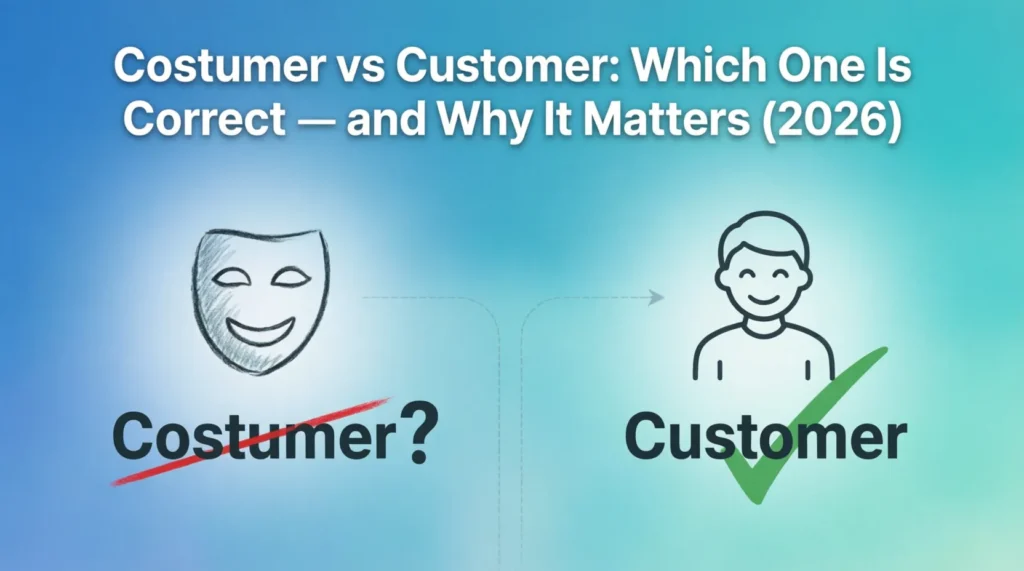
In short, “customer” is the correct word when referring to someone who buys goods or services, while “costumer” refers to a person who designs or wears costumes. The confusion in costumer vs customer is extremely common because the words look and sound similar, but they have completely different meanings you should clearly understand going forward.
The Confusion Around costumer vs customer
You’re writing an email to a client, and you pause for a second. Is it “costumer” or “customer”? It looks right either way, but something feels off. That tiny moment of doubt is exactly where most people get stuck with costumer vs customer.
Maybe you’re a student trying to finish an essay quickly, or you’re typing a product review and second-guessing yourself. You don’t want to look careless, but the words are so similar that your brain starts guessing instead of knowing.
This confusion is completely normal. Even native English speakers stop and think about costumer vs customer because the difference is subtle in spelling but huge in meaning.
What Each Word Actually Means
Let’s make this simple and clear so you never mix them up again.
Customer is a noun. It refers to a person who buys something from a business. It could be a shop, website, restaurant, or service provider. When you think of money being exchanged for goods or services, you’re talking about a customer.
Example: “The customer bought a new phone from the store.”
Here, “customer” is correct because the person is purchasing something.
Now, costumer is also a noun, but it has nothing to do with buying or selling. A costumer is a person who designs, makes, or wears costumes, often for theater, movies, or special events.
Example: “The costumer prepared outfits for the stage play.”
So in costumer vs customer, only one word applies to business and everyday shopping, and that is customer. The other belongs to the world of performance, fashion, and entertainment.
If you remember just this difference, you already solve 90% of the confusion.
costumer vs customer: Side-by-Side Comparison
Here is a quick breakdown to make the costumer vs customer easier to compare at a glance.
Feature
Costumer
Customer
Meaning
Person who makes or wears costumes
Person who buys goods or services
Part of Speech
Noun
Noun
Formality
Neutral
Neutral
Common Context
Theater, film, fashion
Stores, restaurants, online shopping
Example Sentence
The costumer prepared every actor.
The customer requested a refund.
Can They Be Swapped?
No — they have different meanings.
No — they have different meanings.
Why People Mix Up costumer vs customer
The main reason costumer vs customer causes trouble is phonetic similarity. When you say them out loud, they sound almost identical in fast speech. Your brain hears the same rhythm and assumes the spelling must also be similar.
Linguists often point out that English is full of “near-homophones” — words that sound alike but differ in meaning. This is one of those classic cases where spelling tricks your memory even though the meanings are unrelated.
Another reason is visual similarity. The only difference is one extra “e” in “costumer,” which is easy to miss when typing quickly. Your fingers often rely on muscle memory, not meaning, which leads to frequent mistakes in emails, essays, and social media posts involving costumer vs customer.
Finally, autocorrect doesn’t always catch it because both words are technically valid English. That means your device may not warn you, even when your meaning is wrong.
The Simple Rule to Remember Which Is Which
Here’s a super simple way to lock this in your memory:
If it involves buying or paying, it’s “customer.” If it involves costumes or theater, it’s “costumer.”
Think of it like this: “customer = commerce” and “costumer = costumes.”
Now try it in real use:
A customer walked into the café and ordered coffee. The theater costumer designed outfits for the actors. You are a loyal customer when you shop online regularly.
Once you connect the meaning to the context, costumer vs customer becomes much easier to separate in your mind.
Common Mistakes People Make With costumer vs customer
Using “costumer” in business emails: You might write “Dear costumer,” when you actually mean someone buying your product. Correct version: “Dear customer,”
Confusing retail contexts: You may say “customer service costumer support,” instead of “customer support.”
Typing errors in essays: You might accidentally replace customer with costumer while writing about shopping behavior. Correct version: always “customer.”
Relying on sound only: You hear the word in conversation and write it as “costumer,” even when talking about buyers. Correct version depends on meaning, not sound.
Real Sentence Fix — costumer vs customer
See the Mistake, Fix the Mistake
These are real mistakes people make with costumer vs customer — and the simple fix for each one.
❌ The costumer asked for a copy of the receipt before leaving. ✅ The customer asked for a copy of the receipt before leaving. 📌 Why: A customer buys products or services, not a costumer.
❌ Thanks to every costumer who came to our grand opening! ✅ Thanks to every customer who came to our grand opening! 📌 Why: Store visitors who make purchases are customers.
❌ The survey measured costumer satisfaction after each purchase. ✅ The survey measured customer satisfaction after each purchase. 📌 Why: Customer satisfaction is the correct business term.
❌ Please contact costumer support if the app crashes. ✅ Please contact customer support if the app crashes. 📌 Why: Customer support helps people using a product or service.
❌ Every customer backstage checked the actors’ costumes. ✅ Every costumer backstage checked the actors’ costumes. 📌 Why: A costumer works with costumes in theater or film.
❌ My sister is a customer who designs costumes for school plays. ✅ My sister is a costumer who designs costumes for school plays. 📌 Why: Someone who designs or handles costumes is a costumer.
Real-World Examples: costumer vs customer Used Correctly
“The customer left a positive review after receiving fast delivery.” This works because it refers to someone buying a product or service.
“Every customer in the store was offered a discount coupon.” This is correct in a retail or business environment.
“The film’s costumer spent weeks designing historical outfits.” This is correct because it relates to costume design in entertainment.
“As a regular customer, you receive exclusive membership rewards.” This shows professional marketing language used in business communication.
British English vs. American English — Does It Affect costumer vs customer?
There is no regional spelling difference in costumer vs customer. Both British and American English use the same spelling and meaning for “customer” in commerce.
Similarly, “costumer” is universally used in English to describe someone involved in costume design or usage. Linguists agree that this confusion is not regional but purely semantic and spelling-based.
So whether you’re writing in the UK, US, or anywhere else, the rule stays the same: context determines the correct word, not geography.
What Grammar Checkers and Style Guides Say About costumer vs customer
Most grammar tools and style guides strongly prefer “customer” in business-related contexts and will often flag “costumer” if it appears near words like “buy,” “shop,” or “service.” However, they won’t mark “costumer” as incorrect when used in artistic or theatrical contexts.
This shows an important point: spelling alone isn’t enough. Context matters more than automated correction tools when dealing with costumer vs customer.
Style experts often emphasize that understanding meaning will always outperform relying only on spellcheck systems, especially in professional writing.
costumer vs customer in Professional and Academic Writing
In professional communication, using the wrong word can change how your message is perceived. If you write “costumer support” in a job application or business email, it may look like you lack attention to detail.
In academic writing, especially in business studies or marketing topics, “customer” is a key term. Misusing it can weaken your credibility even if the rest of your writing is strong.
The good news is that once you fully understand costumer vs customer, you won’t have to second-guess yourself again. This is one of those small language rules that instantly improves your writing confidence.
Quick Recap: costumer vs customer at a Glance
“Customer” = someone who buys goods or services
“Costumer” = someone who designs or wears costumes
Only “customer” applies to business and shopping contexts
“Costumer” is related to theater, film, and costume design
The confusion comes from similar spelling and pronunciation
Frequently Asked Questions About costumer vs customer
Is it customer or costumer for someone who buys things?
It is always “customer.” This word refers to someone who purchases goods or services from a business. If money is involved in buying or selling, “customer” is the correct choice.
What does costumer mean in simple words?
A costumer is someone who creates or works with costumes, often in theater, film, or fashion. It has nothing to do with shopping or business transactions.
Why do people confuse costumer and customer so often?
People confuse them because they sound almost identical when spoken. The spelling difference is small, but the meanings are completely unrelated, which makes costumer vs customer a common mistake.
Can costumer ever mean customer?
No, “costumer” cannot be used to mean a buyer. Using it in a shopping or business context is incorrect and will change the meaning of your sentence entirely.
How can I remember the difference easily?
Remember this simple trick: “customer” is for commerce (buying), and “costumer” is for costumes (theater and design). Linking each word to its context makes it much easier to recall.
Final Thoughts on costumer vs customer
The difference between these two words is small in spelling but very large in meaning. One belongs to the world of business and everyday transactions, while the other belongs to creative costume design and performance.
Once you understand costumer vs customer, you eliminate one of the most common English writing mistakes in both casual and professional contexts. It’s a simple clarity upgrade that makes your communication stronger and more confident.
Now that you know the rule, you can write without hesitation and trust your choice every time you use these words going forward.
Frequently Asked Questions
What is the main difference between 'costumer' and 'customer'?▼
The main difference is that ‘customer’ refers to a person who buys goods or services, while ‘costumer’ refers to someone who designs or wears costumes. Understanding this distinction is crucial to avoid confusion in professional and everyday contexts.
Why do people often confuse 'costumer' and 'customer'?▼
People confuse ‘costumer’ and ‘customer’ primarily due to their phonetic and visual similarities. The words sound alike, and the only difference in spelling is one extra ‘e’ in ‘costumer’, which can easily lead to mix-ups.
In what contexts would I use 'customer'?▼
You would use ‘customer’ in contexts involving commerce, such as shopping at a store, ordering food at a restaurant, or making a purchase online. Essentially, any situation where money is exchanged for goods or services involves a customer.
Can I use 'costumer' when talking about someone who buys costumes?▼
No, ‘costumer’ specifically refers to someone involved in designing or wearing costumes, not purchasing them. If you are talking about someone buying costumes, the correct term would still be ‘customer’.
What are some examples of sentences using 'costumer' and 'customer'?▼
An example of ‘customer’ would be, ‘The customer requested a refund for the faulty product.’ For ‘costumer’, you could say, ‘The costumer prepared every actor’s outfits for the stage play.’ These examples illustrate the distinct contexts for each word.
How can I remember which word to use?▼
A simple rule to remember is: if it involves buying or paying, think ‘customer’. If it involves costumes or theater, remember ‘costumer’. Associating ‘customer’ with ‘commerce’ and ‘costumer’ with ‘costumes’ can help solidify the distinction.
Does autocorrect help with distinguishing between 'costumer' and 'customer'?▼
Autocorrect may not always help because both ‘costumer’ and ‘customer’ are valid English words. Therefore, it might not flag a mistake even if the intended meaning is incorrect, which can lead to confusion in writing.
James Williams has been fascinated by the intricacies of the English language since his childhood days. Holding a Master’s degree in Linguistics from the University of Cambridge, he has spent over 15 years working as a professional editor and language consultant. James specializes in deciphering complex spelling and grammatical issues, and he is passionate about helping students and professionals alike gain confidence in their writing. His experience includes developing educational content for ESL learners, ensuring clarity and precision in communication. James is dedicated to providing readers with easy-to-follow guidance that resolves word confusions and common spelling errors, making WordlyRight an essential resource for anyone who needs quick, authoritative answers.